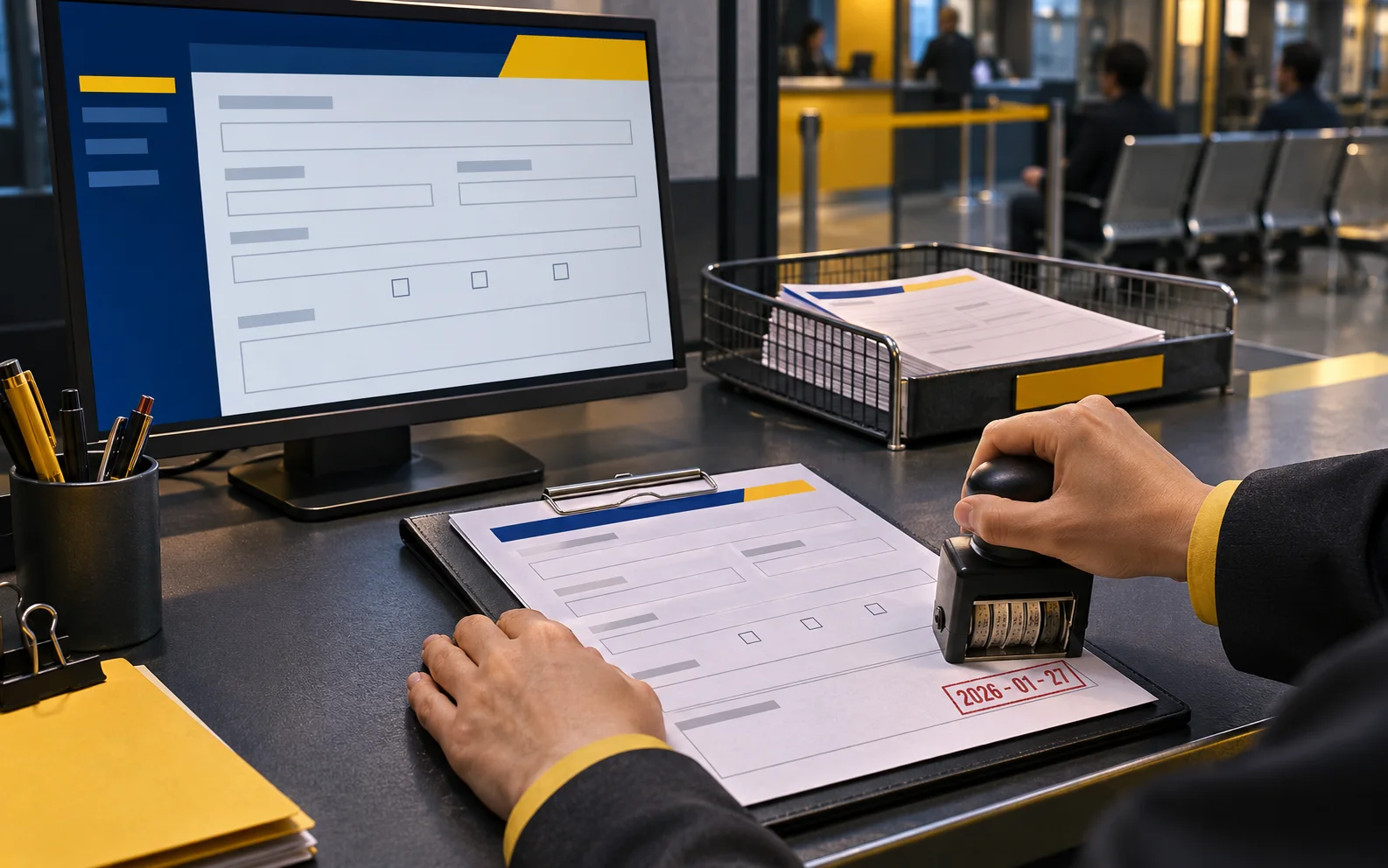
Protect Government Permit Application Templates
Keep one approved blank permit application template, test changes outside the published master, and verify both public release and recovery before a form becomes operational.
Find the next review step
Select what changed. No applicant data is collected.
Build evidence around the complete permit-template lifecycle
A defensible public form must be reproducible by another authorized clerk who did not prepare it. Record the form version, effective state, authority, applications, public channels, expected action and recovery source before changing access or publishing a file. The goal is not merely to freeze a document; it is to preserve an approved blank master while keeping revision, public release and recovery accountable.
Define
Inventory every blank master, working revision, public download, portal copy, counter stock, translation and archived version. Record the expected result, observed result, responsible role and exception so another clerk can reproduce the decision.
Map
Assign the form owner, policy authority, accessibility reviewer, records role, portal publisher, clerk representative and recovery custodian. Record the expected result, observed result, responsible role and exception so another clerk can reproduce the decision.
Prepare
Create a template register linking form version, effective date, permit type, required fields, approval and each publication channel. Record the expected result, observed result, responsible role and exception so another clerk can reproduce the decision.
Test
Rehearse a fictional change through field design, legal and accessibility review, publication, access failure and restore. Record the expected result, observed result, responsible role and exception so another clerk can reproduce the decision.
Verify
Sample public downloads and counter copies after release to prove the intended form—not merely a successful upload—is available. Record the expected result, observed result, responsible role and exception so another clerk can reproduce the decision.
Close
Close superseded forms, temporary copies, broken links and recovery exceptions with named owners and review dates. Record the expected result, observed result, responsible role and exception so another clerk can reproduce the decision.
How the control behaves in public service
A permit office updates a blank application after a fee-category change. Clerks model the field in a working copy, test fictional edge cases, obtain policy and accessibility approval, then publish the exact approved version to the portal and counter. The team verifies both channels and records one partner page still linking to the superseded form.
The result applies only to the recorded form, version, effective date, applications, accounts and publication channels. A material change requires a new review.
Require a second-clerk publication check
Ask another authorized clerk to locate the exact approved form, confirm its effective state, complete a fictional edge-case application and trace every field to its definition. The reviewer should verify a public download and print proof, confirm that a superseded copy is not offered, reproduce required access and locate the independent recovery package without undocumented knowledge.
Close only when each broken link, cache, partner copy or processing exception has an owner, due date and safe instruction. Retest after a form, policy, portal, accessibility, Windows, storage, product, account or distribution change. A successful upload is not proof that the correct public form is usable everywhere.
Operational model
Build a permit-template control system
A reliable permit-form service needs more than a protected file. Start with a named template owner, a controlled master, a documented working-copy process and a publication register. The register should connect each public form to its effective date, approving authority, language, channel and rollback copy. Clerks should be able to answer three questions without opening several folders: which blank form is current, what changed, and where an applicant can obtain it.
Map the complete journey from policy change to applicant submission. Include legal review, field editing, accessibility review, translation, portal configuration, counter printing and retirement of the previous edition. A failure at any handoff can leave an accurate master behind while an obsolete download remains public. Treat website, portal, email packet and counter stock as separate release destinations requiring separate confirmation.
Minimum evidence for every release
- Approval record and named owner for the effective version.
- Field-by-field comparison against the authorized requirements.
- Completed sample using fictional data, including conditional fields.
- Web, download and print checks from an applicant’s perspective.
- Recovery location and tested rollback instructions.
Use the readiness builder below to expose gaps before release. Its result is a planning aid, not proof that a form complies with every legal, accessibility or records obligation.
Verify the public release evidence
Before approving or publishing a form, require a second clerk to reproduce its version, effective date and authority from the register. Complete a fictional edge-case application, trace every conditional field to its rule, compare web and print rendering with the approved blank master and confirm that superseded direct links and counter copies are not presented as current. The reviewer should also locate the independent recovery package and identify any font, linked asset, portal behavior, browser or assistive-technology path that was not tested.
For every release, record the publication time, exact artifact, website and portal locations, counter replacement, accepted download, print proof, redirects, cache state, partner exceptions, rollback source and person who confirmed the result. Assign every discrepancy an owner and disposition. A successful upload is not evidence that applicants can find, complete and submit the correct form through every intended channel.
Failure modes to prevent
- Publishing an unapproved working copy.
- Testing layout with real applicant data unnecessarily.
- Leaving old forms at direct links or public counters.
- Treating file restriction as agency or legal approval.
Direct answers
What must be confirmed before form workshop?
Confirm the exact form version, effective state, agency authority, responsible owner and recovery source before changing access or public availability.
Does file protection approve a government form?
No. Restriction cannot establish legal sufficiency, policy approval, accessibility compliance, public notice or accurate processing.
When should controls be retested?
Retest after form, policy, accessibility, Windows, storage, software, product, account or publication-channel changes.